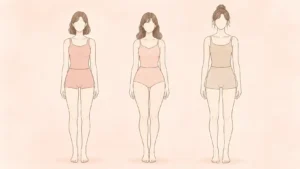

If your body shape self-check gives you a different answer every time, the cause is either that you’re judging by the silhouette of your clothes, or that you’re only looking at parts of your body that shift with your daily condition and water retention. What a professional actually checks during a real diagnosis comes down to just three or four spots around the “bones and joints” — the parts that don’t change much with your weight or body composition. In this article, I’ll walk you through a 5-minute at-home self-check built entirely around those reliable checkpoints.
As a professional stylist for thirteen years, I’ve done body shape diagnoses for more than 1,000 clients. What that experience has taught me is that 90% of people who struggle with self-diagnosis are simply looking in the wrong places. Once you know the right spots, you can get a surprisingly accurate read just by touching your collarbone and wrist — no need to try on a single outfit in front of the mirror.
90% of people who struggle with self-diagnosis are simply looking in the wrong places.
Why does your body shape diagnosis come out different every time?
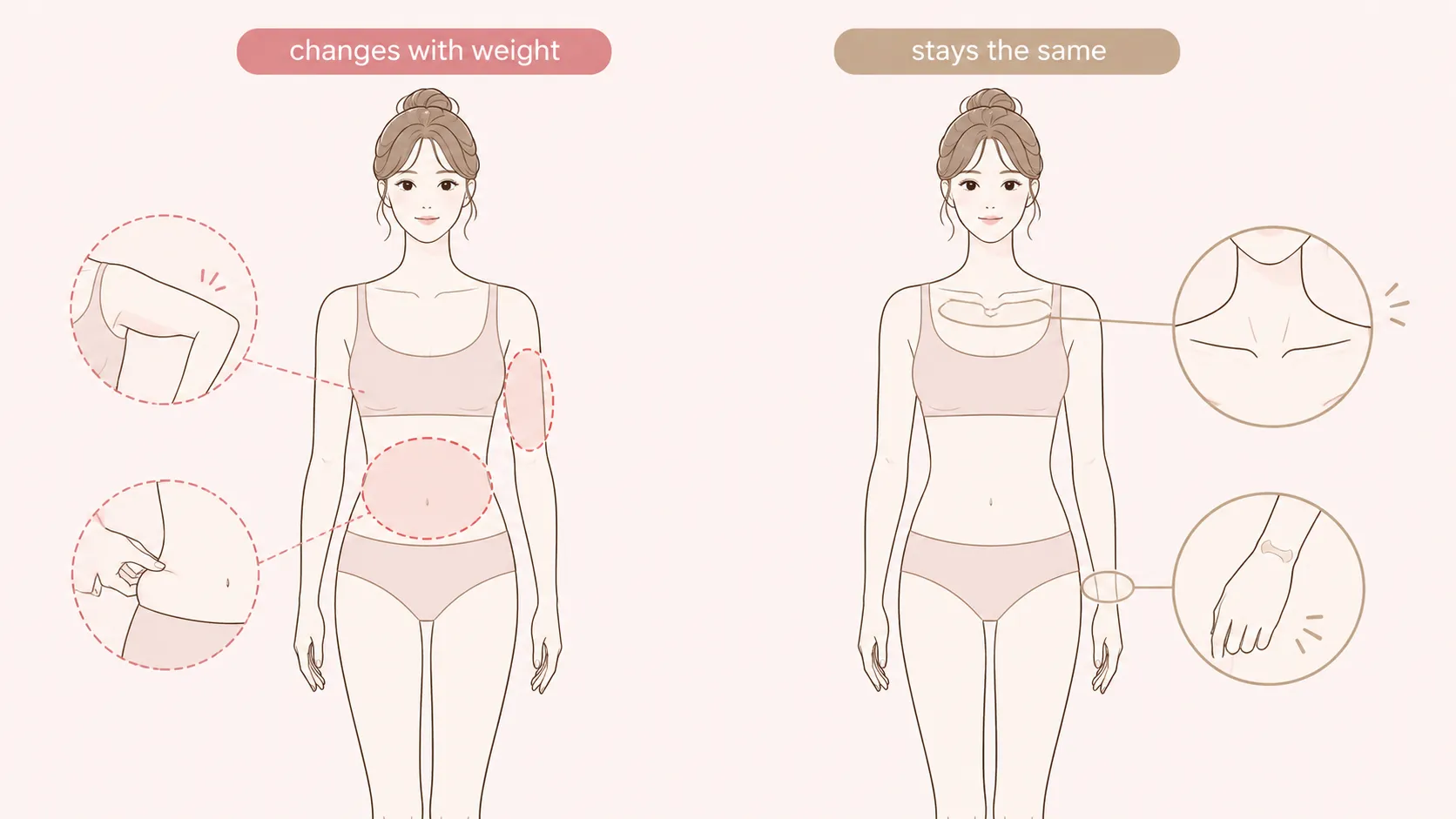
In short, your results keep shifting because you’re using parts of the body that change with weight and posture — like your midsection or the look of your upper arms — as your yardstick.
Your body shape type is determined by bone structure you were born with — the thickness of your bones, the size of your joints, and the balance of muscle to fat — and dieting or aging don’t change your underlying type. That said, after menopause or with age-related muscle loss, the way things feel when you check by touch can change, making self-diagnosis harder even though the underlying standard hasn’t moved. In other words: the standard doesn’t change, but your own sense of touch can become less reliable — worth keeping in mind.
Many of the simple online quizzes mix in questions like “does fat tend to collect on your stomach” or “do your upper arms get heavier easily” — items that shift with weight gain or loss. That’s exactly where the confusion comes from.
I see this constantly with clients: women who come to me after buying frilly blouse after frilly blouse, convinced none of them work. When I ask what led them there, it’s almost always the same story — an online quiz told them “heavier upper arms = Wave type.” But upper-arm size changes with your weight, so it was never a valid signal in the first place. This is an especially common misdiagnosis pattern for women in their 40s and beyond, who tend to carry more weight around the midsection after childbirth or through menopause.
What’s the difference between Straight, Wave, and Natural?
In short, the three types are classified by which is more dominant, muscle or fat, and by how clearly your joints and bone structure show.
| Diagnostic point | Straight | Wave | Natural |
|---|---|---|---|
| How the collarbone looks | Not very visible, sits under the skin | Thin and delicate, visibly raised | Large and clearly bony |
| Wrist bone | Small with some roundness | Small and thin | Chunky and prominent |
| Kneecap | Not very visible | Small, subtle bone definition | Large and clearly prominent |
| How muscle and fat build up | Fleshy, muscle builds easily | Soft, subcutaneous fat builds easily | Bone structure more visible than fat; somewhat flat |
| Neck length and thickness | Shorter, solidly built | Thin and long | Long with a bony impression |
| Overall impression | Structured, substantial | Soft, curved | Casual, relaxed |
| Fabrics that suit you | Fabric with body and structure | Soft, thin fabrics | Rough, matte-textured fabrics |
In the table, “I-line silhouette” refers to a clean, straight-up-and-down shape, while “fit and flare” means fitted through the upper body and flaring out toward the hem. I’ll go through these in more detail, together with photos, in the type-specific outfit sections that follow.
The 5-minute at-home self-check list
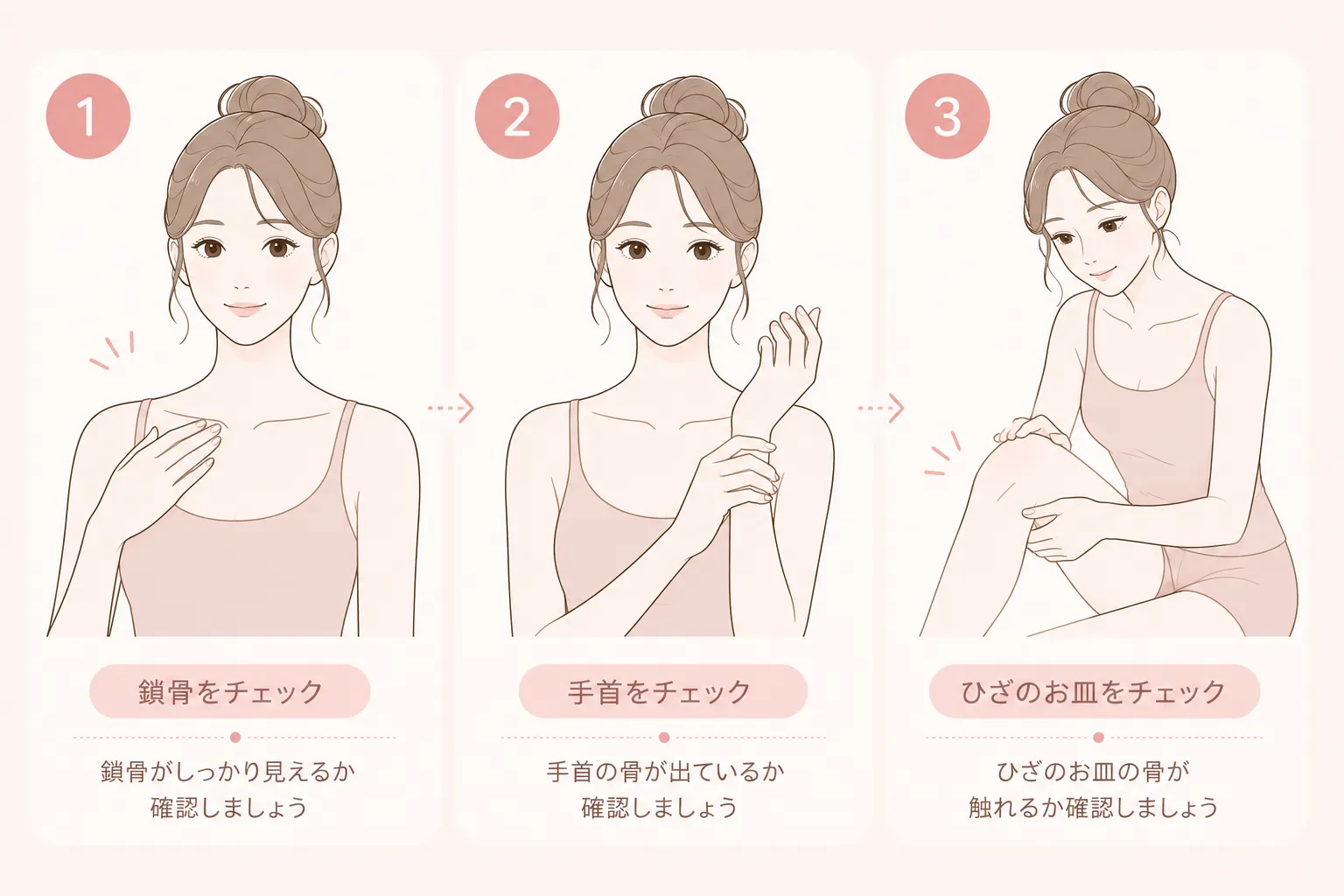
In short, the collarbone, wrist, and kneecap — three spots you check by touch rather than by looking in the mirror — form the basis of an accurate self-check. The key is not relying on how you look in clothes.
One thing to watch for before you start: a lot of people tense up and hunch their shoulders while checking, which buries the collarbone and makes it easy to misread yourself as a Straight type. Roll your shoulders back and relax fully before you check.
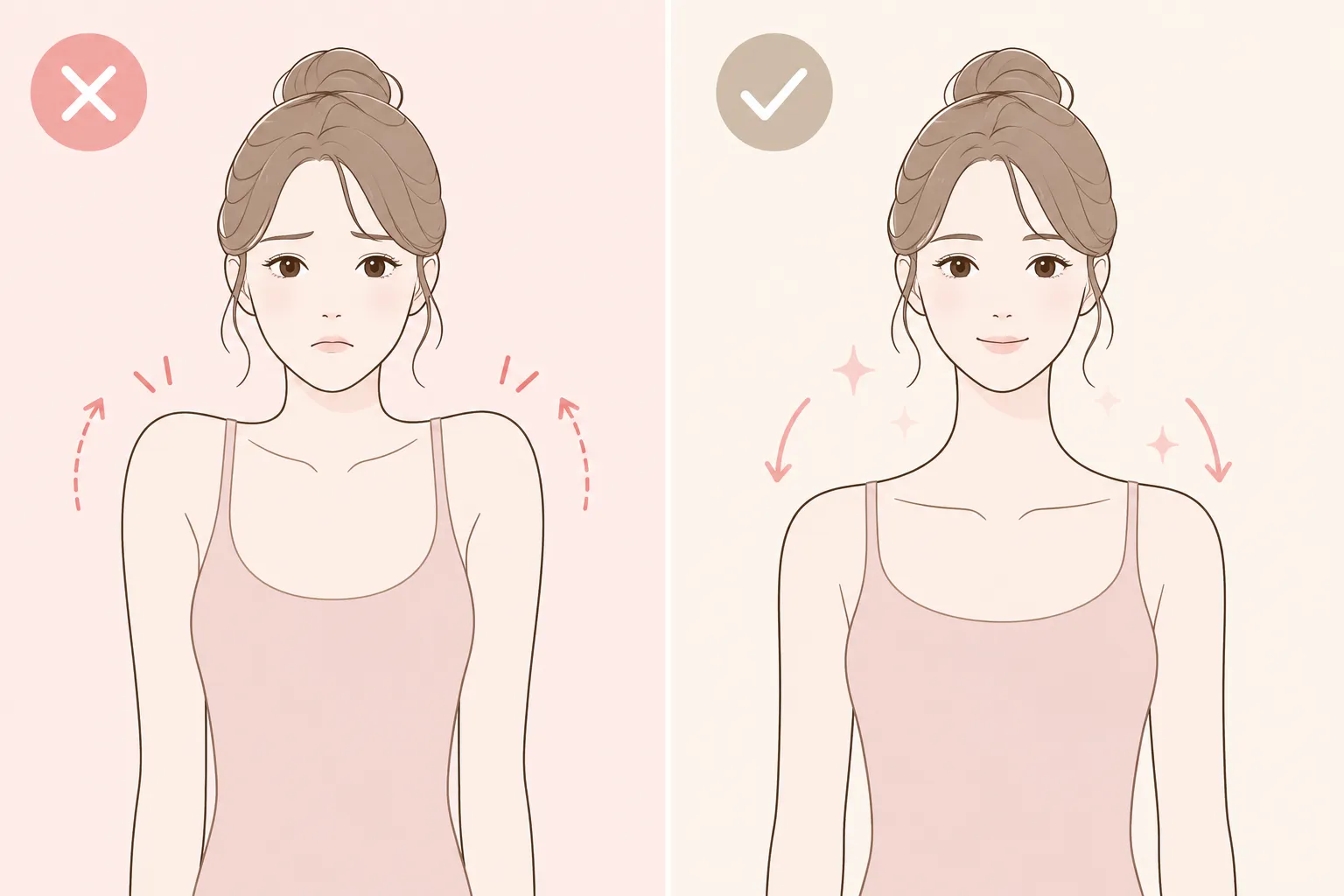
Check #1: Feel your collarbone
Trace your collarbone with your finger. If you can barely feel the bone’s outline because it’s buried, you lean “Straight.” If it’s thin and faintly raised, you lean “Wave.” If the bone is clearly prominent and easy to feel, you lean “Natural.”
Check #2: Pinch your wrist
Wrap your other hand loosely around your wrist. If the bone feels small and rounded, that’s “Straight.” If it feels thin and delicate, that’s “Wave.” If the bone feels large and knobby, that’s “Natural.”
Check #3: Check how your kneecap is shaped
Sit down, bend your knee slightly, and touch around your kneecap. If the bone’s outline isn’t very noticeable, that leans “Straight.” If it’s small with subtle definition, that leans “Wave.” If it’s large and clearly prominent, that leans “Natural.” Along with the collarbone and wrist, this is one of the checkpoints least affected by your weight.
Check #4 (reference only): Bust position, viewed from the side
This checkpoint carries a lot of subjective variance, so treat it as a reference point only. Rather than judging height by touch, it’s more accurate to stand sideways with your shoulder and hip against a wall and check your bust position in a mirror. Higher and more upward-facing leans “Straight,” a little lower and softly rounded leans “Wave,” and lower and flatter leans “Natural” — but shapewear can change the impression here too, so prioritize your results from the collarbone, wrist, and kneecap.
Supplementary check: Look at the thickness of your palm
Take a look at your whole palm. If it has some thickness and a fleshy feel, that leans “Straight.” If it’s thin and delicate, that leans “Wave.” If the bones, tendons, or veins tend to stand out, that leans “Natural.” Use this as a supporting checkpoint that reinforces your three main results, rather than a deciding factor on its own.
How to read your self-check results: Whichever type matches the most across your collarbone, wrist, and kneecap is most likely your body shape type. If you split evenly between two types, you may have a “mixed type” — see the next section for guidance. It’s worth saving this result as a note or screenshot on your phone so you can refer back to it before your next clothing purchase.
What if nothing quite fits, or you seem to be a mixed type?
In short, being a mixed type isn’t unusual at all — plenty of people carry the features of one type in their upper body and another in their lower body. In that case, a practical approach is to treat whichever type shows more strongly as your “primary” and the other as a “reference” when choosing clothes.
In my own practice, the most common combination by far is “Straight on top, Wave on the bottom.” In that case, choosing tops with structured fabric that emphasizes an I-line, while letting bottoms use flares or tucks for softness, keeps the top and bottom from feeling mismatched.
If you’re still unsure, or would simply rather have a professional confirm it for you, it’s worth considering an online body shape diagnosis service or a diagnosis with a professional stylist rather than forcing a decision on your own. Self-diagnosis has its limits — running your important clothing purchases past a professional’s eye, even just occasionally, can significantly cut down on costly mistakes.
By type: what kind of clothes suit you?
In short, each type’s overall look changes dramatically depending on how you choose your “fabric” and “silhouette.” When you’re shopping, try lightly pinching the fabric while it’s still on the hanger. If it springs right back into shape when you let go, that’s a fabric with structure (suits Straight types); if it holds a crease for a while or drapes softly, that’s a soft fabric (suits Wave types) — a quick trick I use constantly out in the field.
What suits the Straight type?
Straight types tend to suit fabric with structure, I-line silhouettes, and simple designs. Keeping tops on the shorter side and true to size tends to show off your shape at its best. That said, women whose midsection has gained some fullness can find that a true-to-size top in structured fabric feels tight and adds bulk rather than reducing it. In that case, the professional trick is to choose fabric that still has body but drapes a little more vertically.
An item like a beige wool-blend tailored jacket (hem length around 58cm, hitting at the hip bone, single-button) — one with structure that still falls in a vertical line — works well both for covering the areas Straight types want covered and for office wear.
Check out the beige wool-blend tailored jacket here:
Amazon /
Rakuten /
SHEIN /
Yahoo! Shopping

What suits the Wave type?
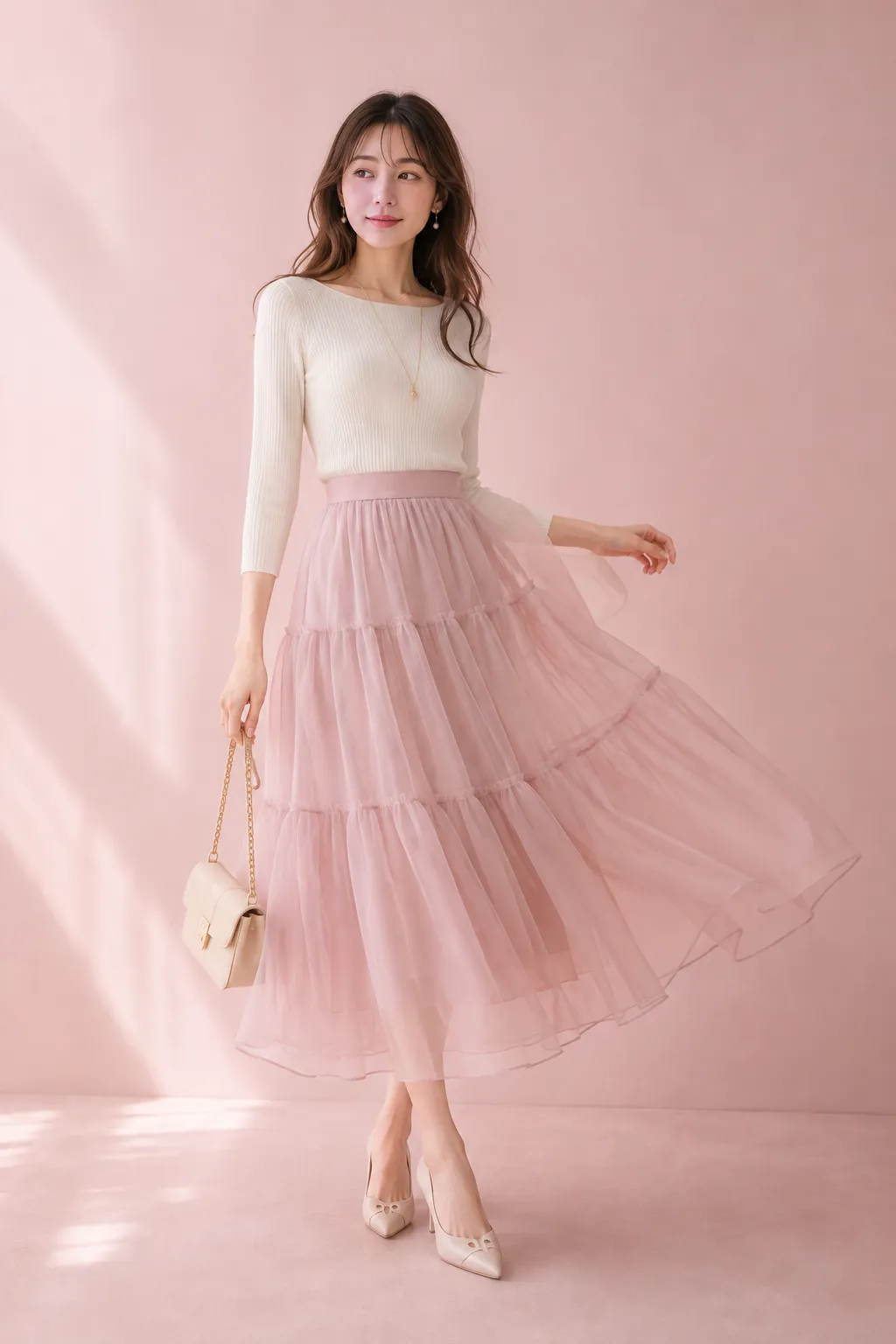
Wave types tend to suit soft, thin fabrics, high waists, and fit-and-flare silhouettes. Decorative details and small, curved prints also tend to work well. The reason is that pairing your naturally curved lines with straight or bold stripes creates a visual clash that can make you look heavier; fine, curved prints don’t fight your body’s lines and let your delicate frame stand out instead.
An item like a dusty-pink organza tiered skirt (elastic waist, midi length) — soft fabric with a gently swaying hem — is the kind of piece that flatters a Wave type’s delicate frame. One note: budget-friendly pieces often skip the fabric details that actually make the difference between body shape types, so always check for sheerness and structure yourself, however low the price.
Check out the dusty-pink organza tiered skirt here:
Amazon /
Rakuten /
[not currently available] /
[not currently available]
What suits the Natural type?
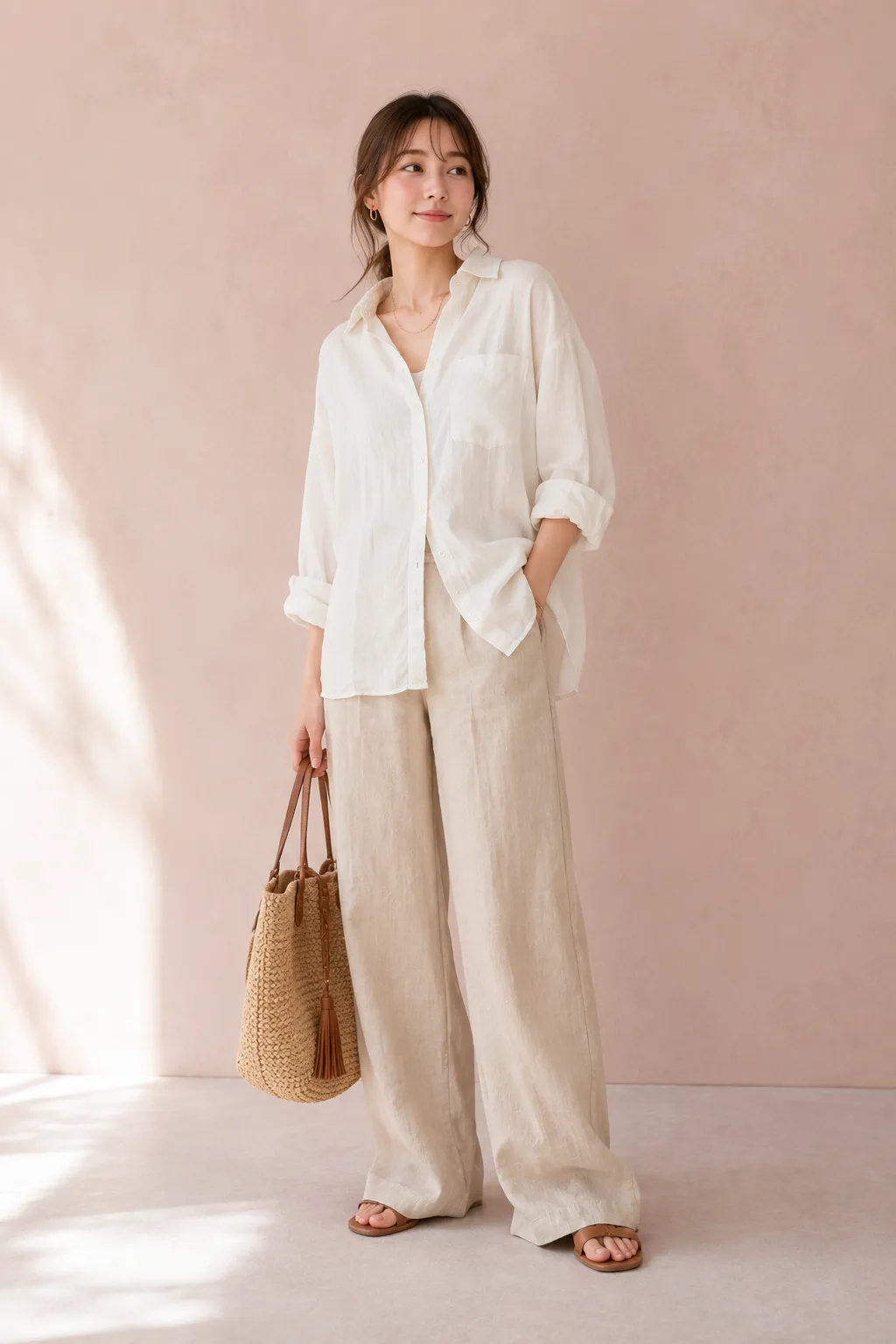
Natural types tend to suit raw, casual textures, oversized fits, and natural fabrics like linen and cotton. A more relaxed styling approach flatters you more than an overly polished design, since it softens your bone structure’s presence just the right amount.
A piece like an off-white linen-blend big-silhouette shirt (dropped shoulders, roll-up sleeves) — a layering piece that drops the shoulder line — plays up a Natural type’s bone structure in a suitably relaxed way.
Check out the off-white linen-blend big-silhouette shirt here:
Amazon /
Rakuten /
[not currently available] /
[not currently available]
If you’d like to go deeper on outfits for your type, check out the full type-specific guides below.
Still not confident in your self-diagnosis?
By this point, the checklist above should have given you a decent sense of your tendencies. That said, the feel of your collarbone or wrist is easy to read subjectively, and it’s especially common for beginners to feel unsure. Body shape diagnosis isn’t about “personal taste in looks” — it’s about reading the relationship between fabric and gravity. The same body shape can look completely different depending on whether the fabric clings or falls away from it, so keeping a reference guide on hand that explains the underlying logic is genuinely useful every time you shop.
A book like “Body Shape Diagnosis Advisor Certification Level 2 & 1 Official Textbook: Understanding What Suits You” (by Yumiko Futagami) covers everything from the basic theory to specific flattering items, and works well as an introduction even if you have no interest in the certification itself.
Check out the Body Shape Diagnosis Textbook here:
Amazon /
Rakuten /
[not currently available] /
Yahoo! Shopping
If you’re still unsure even after reading up on your own, it’s worth trying an online body shape diagnosis service or an in-person consultation with a professional. Self-diagnosis is best treated as an entry point — if you want to cut down on costly mistakes, having a professional confirm your type at least once is genuinely worth it.
Want to start with just one piece?
If you’re thinking “I’ve figured out my type, but replacing my whole wardrobe at once feels like a lot,” start by picking up just one lower-cost accessory or item from the type-specific picks above, and get a feel for what “suits you” actually means. Straight types might start with a structured stole, Wave types with a dusty-toned floral scarf, and Natural types with a linen-blend accessory — anything with a small enough impact on length or silhouette makes for a lower-risk first step.
Your weight may change, but your collarbone and wrist bone structure won’t. Save today’s results and get in the habit of checking back before your next purchase.
Your weight may change, but your collarbone and wrist bone structure won’t.

Frequently Asked Questions
Q. Does your body shape type change with age?
A. The underlying standard for your body shape type — the thickness of your bones and the size of your joints — doesn’t change much over a lifetime. That said, age-related muscle loss, such as after menopause, can make the feel of your collarbone or wrist harder to read by touch, which can lead to self-diagnosis mistakes even though the standard itself hasn’t shifted.
Q. Can self-diagnosis and a professional diagnosis give different results?
A. Yes, it happens. This is especially true if you’re not used to reading the collarbone and wrist correctly, so if you’re unsure, it’s worth considering a professional diagnosis as well.
Q. If I’m a mixed type, which type’s clothes should I prioritize?
A. It’s best to build your styling around whichever type shows more strongly, while partially incorporating elements of the other. For example, if you’re Straight on top and Wave on the bottom, choosing a structured, I-line top with a flared, softer bottom brings the two halves together.
Q. Should I do body shape diagnosis or personal color diagnosis first?
A. Either order is fine, but as a rule of thumb: if you’re mainly struggling with how to flatter your figure, start with body shape diagnosis; if you’re mainly struggling with what looks good near your face, start with personal color diagnosis. Body shape diagnosis tends to have the bigger impact on reducing clothing mistakes.
Q. My self-check results came out evenly split between two types — what should I do?
A. You’re likely a “mixed type.” Rather than forcing yourself into one category, build around whichever type shows more strongly and refer to the mixed-type section of this article when choosing items.