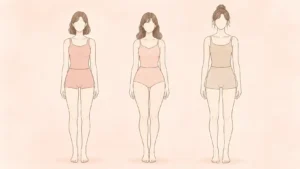

Why Does Self Body-Shape Diagnosis Never Feel “Right”?
The short answer: the biggest reason self-diagnosis results keep shifting isn’t your body shape itself — it’s day-to-day differences in “condition, posture, and viewing angle.” Body-shape diagnosis is meant to look at fixed traits like bone, muscle, and joint size, but when you check yourself, things like slouching or an arched back, or checking in a mirror while wearing clothes that hide your body’s true lines, easily throw the result off.
Gaining or losing weight doesn’t change your body-shape type either, yet many people assume “I must have changed shape since I lost weight.” In 13 years as a professional stylist, I’ve diagnosed hundreds of clients, and most people who struggle with self-checks trip up on the exact same points.
3 Reasons Self-Diagnosis Goes Wrong, According to a Pro
Conclusion: the causes come down to three things — “checking the wrong areas,” “no point of comparison,” and “assumptions.”
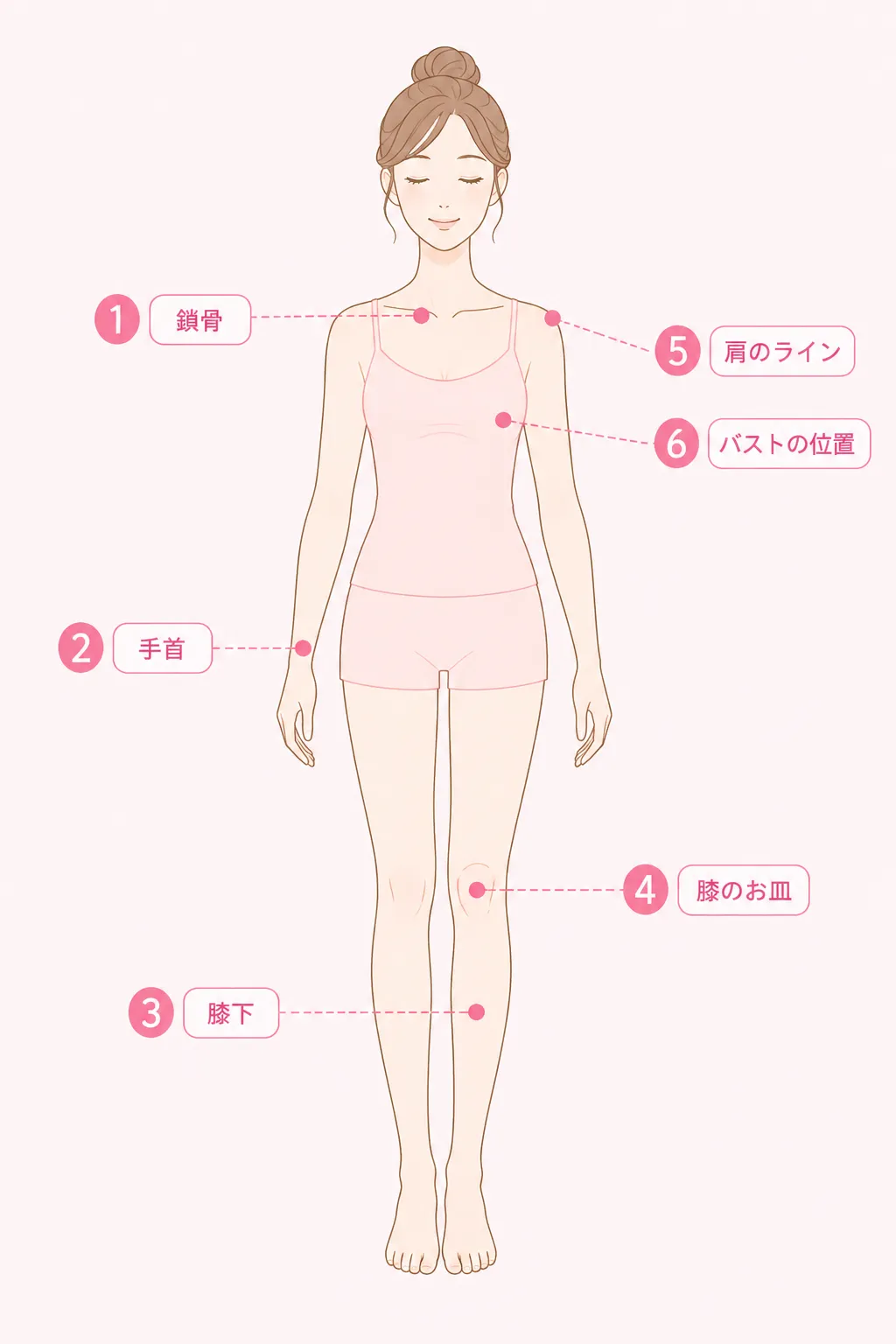
First, checking the wrong areas. What you actually need to look at in a body-shape diagnosis is your bone structure itself — the visibility of your collarbone, the size of your wrist bones, the line from shoulder to collarbone, how muscle sits below the knee, and how your kneecap protrudes. If you judge based on things like a defined waist or upper-arm size — which are about fat distribution, not bone — your result will shift every time your body composition changes.
Second, no point of comparison. Professional diagnosis draws on experience from seeing many people of the same body-shape type side by side. With a self-check, your own body is your only reference, so it’s hard to judge objectively whether, say, your collarbone is more or less visible than average.
Third, assumptions. Many people decide the answer first — “I’m slim, so I must be Straight,” or “I look bony, so I must be Natural” — based on appearance or weight, then interpret every checkpoint to fit that conclusion. Another common trap I see in practice: looking at a diagnosis app or a quick social-media quiz result first, then checking the mirror just to “confirm” that answer, working backward instead of forward.
What’s the Trick to Getting an Accurate Diagnosis?
Conclusion: when you check, stick to three rules — “wear something fitted in front of a mirror,” “check everything in one sitting, same day and time,” and “judge each checkpoint individually, then take a majority vote at the end.”
First, change into something that shows your body’s true line (a camisole, leggings, etc.), stand up straight, and face a full-length mirror. Slouching or arching your back changes how your joints appear, so correcting your posture matters more than most people realize. In practice, we don’t just look at the collarbone — we gently trace it with a finger. Feeling whether the bone is noticeable through the skin gives a more reliable read than sight alone. Comparing your collarbone line with your arm relaxed at your side and again with it lightly extended forward also cuts down on assumption-driven misreads.
Next, check all six points in one sitting: collarbone, wrist, below the knee, kneecap, shoulder line, and bust position. Because swelling and general condition change from day to day, it’s important to look at everything in a single session rather than spreading it across days.
Finally, judge each of the six checkpoints individually as leaning “Straight,” “Wave,” or “Natural,” then take whichever type comes up most often as your provisional result. Don’t decide from a single point — use a majority vote across multiple areas. That’s the pro trick that sharpens self-diagnosis accuracy. Note that a meaningful number of people are a genuine “mixed type,” showing different characteristics in the upper versus lower body. If your results are split, I’d recommend weighting the upper body (collarbone, shoulders, bust position) more heavily. The reason is simple: how a neckline or collar suits you — the part that shapes a first impression — depends more on upper-body bone structure than on the lower body. If you’re a mixed type, choosing tops based on your upper-body type and bottoms based on your lower-body type helps avoid a mismatched, top-to-bottom look.
Common Self-Diagnosis Mistakes I’ve Seen as a Stylist Based in Malaysia
Conclusion: in a hot, humid climate, misdiagnosis often comes not just from swelling but also from “getting chilled by air conditioning” — that’s what 13 years of styling in Malaysia has taught me. Malaysia’s outdoor air is hot and humid, while shopping malls and offices run the air conditioning hard, so over the course of a day your body alternates between “swelling outdoors, then tightening up as it cools indoors.” Check yourself right after coming home in the evening, and your legs and fingers may be swollen enough that the bone definition below your knee or at your wrist looks rounder than it really is.
I’ve had clients living locally tell me, “my self-check flips between Natural and Wave every time” — and when I dig into the details, the timing was almost always evening, right after a trip to the mall. Have the same person check again in the morning, after spending some time in air-conditioned indoor air, and the result often stabilizes. I’ve also noticed that it can be hard to find well-fitted inner layers at local shops in Malaysia, so many people end up checking themselves in loose-fitting inner wear that obscures their true body line — a stumbling block that seems particularly common among women living abroad. Unlike Japan, where humidity shifts with the four seasons, Malaysia’s year-round mix of “hot and humid outside, dry and air-conditioned inside” makes the time and place you check yourself part of the hidden trick to a more accurate self-diagnosis.

What Should You Do If Your Results Are Split?
Conclusion: if you’re torn between two types, the practical approach is to try both types’ recommended looks and go with whichever one makes you look more at ease or gets you more compliments. Body-shape diagnosis is a map for choosing clothes that suit you — it isn’t a test with a single “correct” answer.
If you’re split between Straight and Wave, try each type’s coordinates for about a week and compare how people react and how comfortable the outfits feel. If you’re still unsure, or you’d rather have a more solid basis for your shopping decisions, a professional online body-shape diagnosis is worth considering.
Ready to lock in your body-shape type with a pro’s help? Start with an affordable online diagnosis → Our Top Online Body-Shape Diagnosis Picks (coming soon)
Tools That Help You Self-Check More Accurately
Conclusion: a full-length mirror and a well-fitted inner layer that shows your true body line are the two essentials — get these two and your self-diagnosis accuracy jumps significantly. They help you catch posture habits and swelling you’d otherwise miss.
Full-length standing mirror (36cm wide × 149cm tall, shatterproof):
Amazon /
Rakuten /
Yahoo! Shopping
If your posture or angle tends to drift every time you check, simply keeping a full-length mirror by your bathroom or closet makes your self-diagnosis results far more consistent.
Well-fitted camisole that shows your body line (UNIQLO AIRism women’s seamless camisole):
Rakuten /
Yahoo! Shopping
It skims the body without clinging too tightly, while still showing your bone structure clearly — a great piece to keep on hand specifically for self-checks.
FAQ
Q1. Can I redo my self-diagnosis as many times as I want?
A1. Yes, as many times as you like — but try to do it on the same day and at the same time (ideally morning), standing with good posture.
Q2. Which is more reliable, self-diagnosis or a professional diagnosis?
A2. In terms of pure accuracy, a professional diagnosis wins out. But if you stick to the three self-diagnosis rules — the right checkpoints, the right timing, and the right judging method — you can expect solid, practical accuracy on your own.
Q3. Does your body-shape type change if you gain or lose weight?
A3. Your body-shape type itself is based on bone structure, so it basically doesn’t change with weight gain or loss. That said, changes in fat distribution can alter how things look and lead to a misdiagnosis. If you’re unsure, prioritize the areas fat doesn’t tend to affect — collarbone, wrist, and kneecap — and you’ll be less likely to be thrown off.
Q4. Can I still self-diagnose accurately during a season when I swell easily?
A4. Avoid the times of day when swelling is worst (usually evening onward), and check yourself in the morning when your body is at its least swollen. This matters even more in a hot, humid climate like Malaysia’s.
Q5. What should I do if I’m split between Straight and Wave?
A5. Try coordinating outfits for both types and judge based on comfort and how people respond. If you’re still torn, a professional online diagnosis is worth considering too.